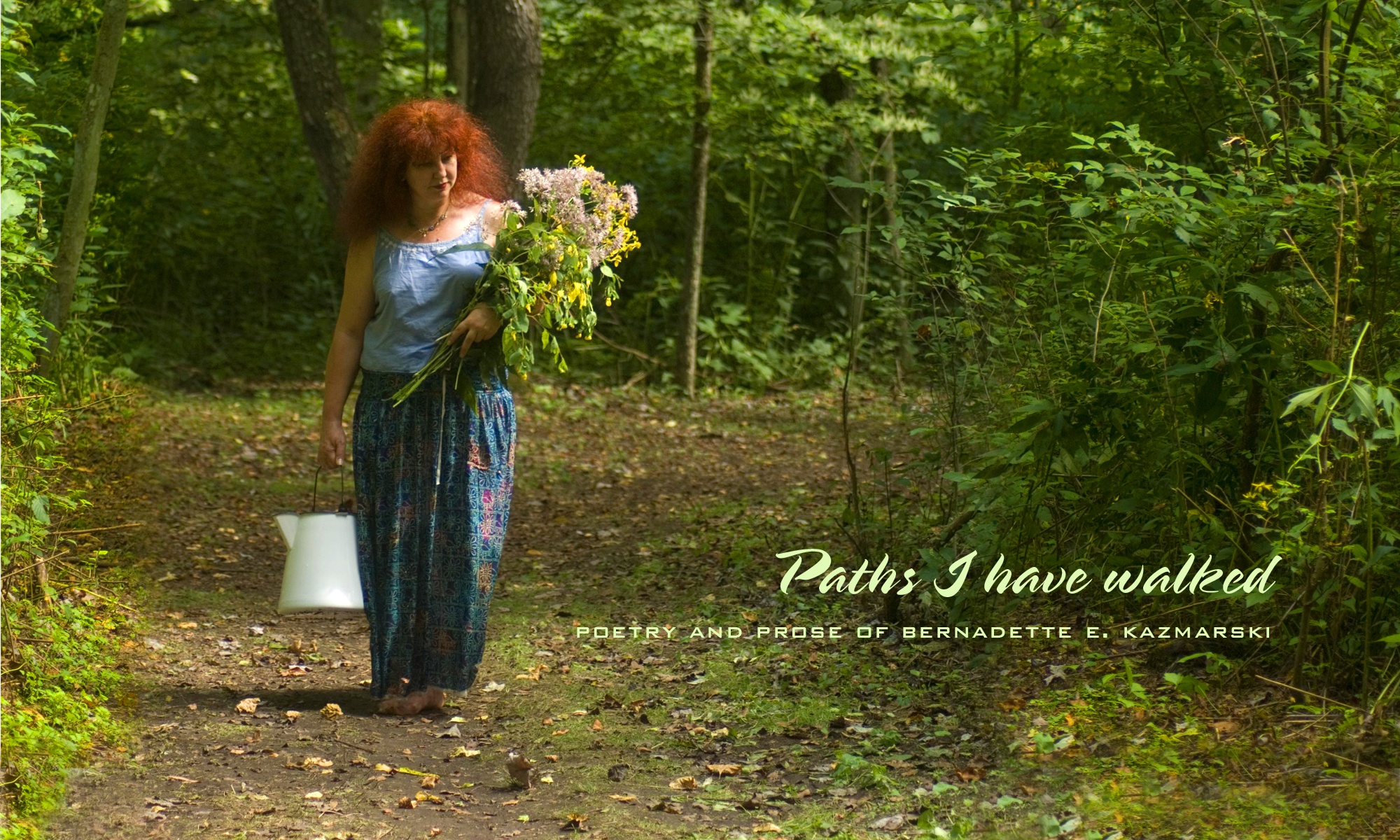
There’s something special about the garden in the morning. The metamorphosis of earth from night to day brings tiny metamorphoses and miracles to all that lives and grows.
I’ve been gardening for decades. Just two years ago, when one of my own trees fell on my garden and fences it finished off the work that two neighbors’ trees had done to other parts of my yard. It’s not manicured, it’s a backyard wildlife habitat with lots of native plants along with shrubs and trees and perennials, and my vegetable garden. My habit even in winter was to start the day with a time outdoors, always work to do, but then I’d find some magic, water droplets, a spiderweb, newly sprouted beans, and off I’d go into a creative wonderland, taking this visual inspiration into any direction I chose: photography, painting, poetry, essay, concept, metaphor.
Even before I began working at home as a creative person this was the best way to start the day, get my exercise and burn off my early morning energy, and awaken those creative sensibilities. I’ve missed it since I’ve been trying to rebuild my yard, and trying to spend every moment working instead, but I knew at some point I’d have to return. I remembered the magic.
Who is telling me a story?
Whose legs wore the paint so thin on that rounded oak edge?
Who sat for breakfast in these chairs?
Who listened to family stories?
Now that our histories are linked by chance
I want to know who you are.
I’ve been working out in my back yard where the forsythias have leafed out after the blooms have faded and these two chairs have weathered two more years outside in the weather. The two painted chairs were plant stands at the ends of my driveway; the unpainted chair fell to pieces and, any finish on its surface washed away by weather, is headed to the bottom of the compost bin to decay like any wood, and one day become a part of my garden.
I remember this poem when I look at them. This year I decided it was no longer in progress. I thought of many more questions as I considered making changes but the ones in this poem were the first ones that came to mind and I’ll go with that.
I have a fondness and also a certain protectiveness for older things that have been discarded. I’m always pulling chairs out of others’ trash, seeing they still have some use, and I don’t want them to spend the end of their useful lives in a landfill. I’ve often used them in my house for a while, then when their joints begin to loosen and paint begins to peel, they have their next life in my garden, often for a decade or so, as decorations, plant stands, even actually sitting places.
Cleaning out under my deck this spring I knew I had about six of them under there, and I’d blocked them in with garden hoses and such. Time for them to get back to work. I decided this was a great spot for these three chairs to at least spend some time, and after I’d walked back to my work area and turned to look at them, these three old oak chairs, their loose panels, peeling layers of paint in colors through the decades, the front edges worn smooth from legs, started telling me a story. So I wrote a poem.
Actually, I recorded my thoughts on my phone, and this little poem is exactly what I recorded. I find I often do better speaking my thoughts as notes than actually trying to write things in moments like this.
Four years ago who would have thought Ukrainians would still be suffering under bombardment in Putin’s military invasion and continued attempt to own Ukraine? He wants to take the world back to previous centuries of continuous warfare of one country against another, not stopping until enough people have been killed, killing whole generations of youth in both countries.
With their innovations Ukrainians have changed the way battles are waged with drone warfare, but the bombs still fall, now from drones instead of planes and ships and on the battlefield.
Ukraine cannot and will not give up because she is a sovereign country and the land and all that is in it belongs to Ukraine. Ukraine cannot and will not give up because that would mean consigning a portion of her population to Russian rule.
The Ukrainian people are intensely creative as artists, musicians, writers and performers who turn their feelings into art. I feel that creativity is my heritage for all I do today.
I actually took the reference photo for this while walking on a local trail in 2020, but even then I wondered, as I always have, why one of the places I have always sought has been an open field of ripe grains with a big blue sky above.
I had intended to paint from the photo I’d taken in 2020, but I had no time for painting that year. But when the war began in Ukraine I knew the time had come and I painted this at the end of March 2022, a month after the Russian invasion of Ukraine. I wasn’t sure what I would do with it or even what I’d title it, but it was such a strong visual I practically had no choice but to paint it. After a few weeks and the war continued on I decided I would title it by the phrase that began and/or ended all remarks from Ukraine, and a phrase I’d heard growing up among second generation Ukrainians: Slava Ukraini, Glory to Ukraine.
A heritage stolen from me
The Ukrainian people are intensely creative as artists, musicians, writers and performers who turn their feelings into art. I feel that creativity is my heritage for all I do today. But I will never know my Ukrainian ancestors or their lives because the areas where my mother’s parents, both orphans, emigrated from were torn apart in WWI, starved by Stalin then torn apart again in WWII, then hidden inside the USSR until 1991 when Ukraine gained its independence. My aunt, their daughter, traveled several times to the approximate areas they came from but was always uncertain about the people she’d met being actual relatives. Today on ancestry sites the best I come up with is fourth and fifth cousins who all seem to be dead ends in trying to find family.
But still, from the time I was very young, before I even had any concept of country or heritage, that field, that big blue sky, somehow spoke to me and let me know where I somehow belonged.
Where did I see that field? In my thoughts, I’m sure, but our homes were built on an old farm, the center of which still existed across the street from us. Beyond that was a hillside pasture, golden grasses as tall as me in summer, and the blue sky above. As soon as I was permitted to leave the yard I was there, and spent hours there in all seasons with the wind and the wildlife. I felt it was infinite, yet it was surrounded by homes and roads.
Strength and Independence
1911, my grandmother on the right in the darker dress, as a young teenager soon after arriving here.
My mother’s parents emigrated from Ukraine and while I never had the chance to get to know them I have always felt a connection with the country and her people.
In 1910 my mother’s mother, Paraskewia Swentkowsky, on the right in the dark dress in the photo above, emigrated to America from what was then called Ukraine. She came from a village near Lviv, in an area that in any given minute in that era between Czarist Russia and WWI could have been ruled by Russians, Poles, Hungarians, Austrians or Germans.
If not for the courage of that young teenager sent over here for a better life than what that turbulent country in that violent era could offer, I, or some version of me, might be in the midst of a Russian invasion right now. That is, if we had all survived being in the stomping ground in WWI, starved and slaughtered by Stalin before WWII, being stomped on again during WWII, and living imprisoned in the USSR until the early 90s when the country broke up and Ukraine finally became an independent country.
She had lost both parents and as an orphan been moved around from one relative to another on the small plots of land they farmed. As a young teenager someone packed her off to the land of opportunity, alone, to meet up with a few relatives who had already emigrated. I know nothing of her life before she emigrated aside from that legend, and nothing of her journey, except that she had had her long blonde hair shaved off at Ellis Island because of lice, and it grew back in strawberry blonde. That was apparently a more interesting detail to my mother than how a 13-year-old got from Ukraine to Carnegie, PA to join up with distant relatives and start a new life, not speaking English, with no education, and probably very few skills that matched with jobs in this land so very different from the one she’d left.
But she did, and lived as full a life as one could live in America in the aftermath of WWI, the Roaring 20s, the Great Depression, WWII, and the Happy Days of the 1950s. She died when I was very young so I never got to know her or hear her stories.
But I know that Ukrainians, and Poles, the other side of my family, having lived through generational traumas of wars and famines for centuries, are strong and determined people, and have fought for their independence as individuals and as nations every time the invading force looked away for a moment. As they watched this act of war become a reality, they could have looked at the overwhelming monster coming to stomp on them and either run away or capitulated, but they did not. This act of war will not end well for anyone, but my bet is that the Ukrainians, especially with the support promised by the rest of the world even without the United States now that this administration has found it not in their interester (though it is still fully in the interests of we the people) will have their freedom, and their country, at the end.
Some of my thoughts over the years from when it all began…
I drafted the poem on the trail on a Saturday in early March, what happens when I come face to face with nature on a trail feeling the earth beneath my feet and the sun and breeze filling my head and my thoughts. I have been singing the song since the invasion began and was singing as I walked along, and every so often wrote another line of my thoughts.
Someday They Will Sing
where have all the flowers gone,
long time passing,
young ones have picked them,
every one of them
gone for soldiers,
returned to graveyards
everyone,
and graveyards gone to flowers,
long time ago,
and again and again
and again
when will they ever learn,
why did they never learn
(#SlavaUkraini, and for all other people oppressed by war.)
The song “Where Have All the Flowers Gone” was inspired by a traditional song of the Cossacks, Slavic peoples who lived in rural regions of both Ukraine and Russia, though the source of the song is Ukrainian. Pete Seeger adapted some of the lyrics and wrote the first three verses in 1955, Joe Hickerson wrote the rest in 1960.
It once was that men marched off to war while women stayed behind and tended the flowers in the graveyards, but I have heard a few folk singers (can’t remember) who have sung lyrics updated to reflect that young women become soldiers as well as young men, in fact, young people of all sorts become soldiers. With both society’s norms and folkways and beloved folk songs, breaking the mold can be difficult, but I could finally feel an update was natural.
I watch the creative soul of Ukrainians in this fight, so many musicians, artists, poets, writers, playing piano at the borders, making art to describe the conflict and their opposition, making Molotov cocktails instead of beer, a brass band of soldiers standing in fatigues to play the Ukrainian national anthem around the spot where a Russian missile hit, and the least I can do is awaken my own, possibly my inheritance from my Ukrainian ancestors, to reflect my support.
When I took this photo it was not lost on me that the sky is blue at the top and yellow at the bottom, and as I searched for a metaphor the 1969 anti-war song came to mind:
Day is Done
Peter Yarrow -Silver Dawn Music – ASCAP
Tell me why you’re crying, my son
I know you’re frightened, like everyone
Is it the thunder in the distance you fear?
Will it help if I stay very near?
I am here.
Refrain:
And if you take my hand my son
All will be well when the day is done.
And if you take my hand my son
All will be well when the day is done.
Day is done, Day is done
Day is done, Day is done
Do you ask why I’m sighing, my son?
You shall inherit what mankind has done.
In a world filled with sorrow and woe
If you ask me why this is so, I really don’t know.
(Refrain)
Tell me why you’re smiling my son
Is there a secret you can tell everyone?
Do you know more than men that are wise?
Can you see what we all must disguise
through your loving eyes?
Black velvet draped land yet colors awaken from deepest soot through cool blue through violet to magenta yellow glaring white waits for that moment last sliver of sun on the horizon laughs with warm colors in that dark sunset
I don’t want to be
colorblind,
I want to paint
what I see,
the colors of our faces
like flowers,
not different
but tones of each others’
faces
as we turn toward the light,
we blend so beautifully.
The illustration above is a sampler of all the shades of pastel I’ve used while painting portraits and sketches of people of all different “colors”, skin tones and ethnicities. All of them appear in all skin tones. Tell me, who is “black” and who is “white”? And what does “colored” mean?
In truth, we are all “colored”. Each of our faces has the darkest and lightest tones and all those in between, and even some colors we’d be surprised to find in skin tones. I can tell you that all the colors I smudged there have appeared in the highlights and shadows and mid-tones of every face. It largely depends on where you are standing in relation to the light.
Some people have suggested that Dr. Martin Luther King, Jr.’s dream of black children and white children going forward hand in hand, the ideal of seeing a person not for the color of their skin but for the content of their character, had the goal of a “colorblind” society. That’s a noble ideal on one hand, where we just don’t notice the color of a person’s skin in any situation and go on from there.
But does that truly bring justice to wrongdoing and change society in a way that makes the injustice people have suffered because of that color unacceptable? To suddenly begin to ignore the color of a person’s skin and jump immediately to integration is to jump right over the injustices done to people because of the color of their skin. It’s also ignoring an essential part of another person, shutting the door on a section of their life, a part that makes them distinctive. King did not use the term “colorblind” in any speech or written document, but his point is described by historians as a more “color aware” society where we recognize our differences, celebrate them and thereby heal through those very differences among ourselves.
When I create a piece of visual artwork I look for what makes the subject inspiring to me, what makes it distinctive, what makes me excited to share it with you. I like contrasts, I find what makes my subject different in its class, what makes it stand out from its surroundings. It’s my joy to find and share “the extraordinary in the ordinary”. If everything I painted looked the same, what need would there be for artwork?
Looking at people has always been like looking at a field of flowers for me—I find it hard to settle on one before I skip to another while I enjoy the visually exciting effect of all those different colors and shapes and heights and structures. Then I can can pause on each one and get to know each in its own unique detail.
When I rode the bus, long before I painted anything let alone a human portrait, I quietly studied all the faces around me for color and shape and texture, eye color, the hair that framed it, accessories and jewelry, and was often started by a stern expression of someone who didn’t understand why I studied them so intently. I was just looking for the things that made them unique and beautiful—not in the classic sense of beauty but in the classical sense, in that beauty is truth, in being true to who we are inside showing that on the outside, like the flower in the field that can’t help but be what it is.
If we are colorblind, we intentionally ignore some of the fundamental differences that make each of us irreplaceable. That denies a basic part of our personal existence and of human existence as a species; it denies a portion of our very identity as an individual.
That takes an awful lot of effort. Why not admit to our differences and get to know each other in full, and find the beauty in each of us. We have always been and will always be different from each other and might as well get used to it.
My garden waits under a blanket of spring
gently rippled snow comforting the earth
drowsing buds protected undercover
will burst and pour forth
hot, humid mornings, big yellow spiders, baskets of green beans
this heavy cover now protects, will melt and nourish.
When I look at my garden, surprised at all its hillocks and gulleys remembered full of life and covered so deeply and densely with growing things, I wonder how the miracle ever happens again that I have baskets of beans and tomatoes just a few months later when all seems frozen and gone. It’s really not. As one of those ironies of nature where unrelated processes fit together like a puzzle to make a whole ecosystem, it’s the icy blanket of snow that would seem to smother and freeze and end the potential that actually keeps the spark of life warm.
The mornings this September have had that particular autumnal cool with a little mist and I thought the spell might have been broken. But the morning this September 11 is sunny, blue, and warm, and eerily quiet, so much like that morning 24 years ago when I was painting a couple of wooden chairs with white paint, dressed in shorts and a tank top, after picking a basket of tomatoes from the garden.
No painting this morning but gardening for sure, and I stood for a moment and let that day come back to me, listening to NPR and hearing about the first plane about 8:50 a.m., and paying close attention after that wondering if, feeling that, there would be more to the story. Twenty minutes later I got my answer, and suddenly the beautiful morning and painting the chairs was far less important than it had been.
September 11
Aside from being in the mid-Atlantic region of the United States, I am nowhere near New York or Washington DC. I am, however, barely an hour away from Shanksville. On the hot sunny morning of September 11, 2001, I was just finishing work outdoors in my back yard when I heard on the radio that a plane had the North Tower of the World Trade Center. Thinking it was an unfortunate accident I continued listening to the radio for details and 20 minutes later heard that a second plane had hit the South Tower and knew instinctively, as I’m sure we all did, that it was no accident.
My radar for tragedy was sensitized; just a few months before my mother had unexpectedly nearly died after lung cancer surgery, held on for six weeks then miraculously awakened from a near-coma one day and gone on to recover, rehabilitate and return home, though weak and fragile, needing my constant support. The previous year my brother had suffered a traumatic brain injury in an accident and at that time lived in a nursing home 30 miles away. I was integral to their recoveries and care and was legal guardian and power of attorney, and my carefully-planned self-employment was unraveling.
When I heard the news, I was out on my garden patio by the basement door, putting another coat of paint on some vintage wooden chairs I used on my deck before winter would peel the last of it off. Garden cat Moses was dozing on the warm bricks, soaking in the sun, the tip of her tail gently tapping the bricks in contentment. I always worked in my garden and did small projects early in the day to make sure they got done before I hit my computer, and to make sure I didn’t hit the computer as soon as I got up and stayed on it all day long. It was a hot, sticky late summer morning, my verdant garden a green jungle, birds twittering everywhere stocking up for migration and winter, and work waiting for me indoors. The first report that it was likely an accident, planes had hit buildings in the past, staved off some worry. Then the second plane hit when everyone in Manhattan was looking at the towers and saw the direction, the turn, the increase in speed prior to hitting the tower, and suddenly a perfect morning had turned unreal.
Jets fly overhead all the time. I have lived in the flight path for Pittsburgh International Airport all my life, and just as close to an Air Force base, and not only do they fly overhead, they circle and slow down and make noise and fly at crazy angles as they come in for a landing. A noisy plane flying low overhead is something I didn’t even notice. But two planes had just hit the two towers of the World Trade Center and a third had hit the Pentagon. I suddenly noticed that the sky was very quiet for that time of the morning.
After the plane hit the Pentagon, I put Moses inside the basement, much to her consternation, as if she needed to be protected from what might be happening, and I suddenly felt exposed under the clarity of that blue sky. As the story grew I thought of my mother and brother and if I should get them and put them somewhere just to make sure they were safe too. Everything seemed suddenly slightly askew.
Then in the increasing quiet as traffic cleared the roads, in that empty perfect clear blue September sky, a single plane went overhead and my hackles rose, a cold tingle running to my fingers on that warm morning as I watched it seeming to struggle through the sky overhead. Shortly thereafter we heard about the crash in Shanksville and I imagined the comforting familiarity of perfect green rolling hills of my Western Pennsylvania home bathed in morning sun, now wrenched open and strewn with the wreckage of violence.
I hurried inside, no longer feeling safe under that warm blue sky. I thought of my mother in her home about a mile and a half away, still weak and needing daily assistance for most activities, many prescriptions and home oxygen. If all this was suddenly disrupted, what would I do? Should I go to her house now? Should I try to get her to a more secure place, like a hospital?
And my brother in the nursing home 30 miles north of me, continuing his recovery from a traumatic brain injury the previous year, also requiring a lot of daily care, medications and supervision. Should I try to move him closer? What if I couldn’t get to him?
And my sister a few miles away with her younger daughter and grandchild? And my niece and her three babies, one of them just six days old, a few miles in the other direction? Should we all find a place to go?
Anyone else would have run for the television, but I didn’t have one then, and I don’t have one now, so I never got to see the very first images that showed up on CNN that morning, heard the fear in the newscasters’ voices. I listened to the familiar voices of the local and NPR reporters describing the events on my radio, feeling calmer listening to their words and being able to move around my house than I would have being trapped in front of a television. I called my mother and later went to her house and watched there.
Did any of us know what to do in those first hours and days, even those of us so far from the terrible scenes of death and destruction more horrible than we could imagine?
It wasn’t until the gentle, perfect beauty of September 12 that the effects of what had happened became reality for me. Not only do I live very near Pittsburgh International Airport, I am also at the intersection of two interstates right outside of Pittsburgh and hear the noises of all this traffic every day, especially in the morning. The next day, with travel restricted on land and in the air, was so eerily quiet. The beauty of the warm sun and clear blue sky, the peaceful twitters of birds and hum of bees we could rarely hear with traffic and daily noises, the clear views of the tree-covered hills made the morning seem like paradise at first, as if everything would be okay after all. But the clear stillness became unnerving as the hours of daylight passed and we had no more of our questions answered, nor knew the extent of the damage and death as it was still unfolding in all three areas.
Perhaps those perfect September days were given to calm us before we learned how our lives had changed.
September 12
Today looks no different from yesterday but forever against the backdrop of a blue September sky we will now remember the loss of our innocence.
September 11 was a blur of images and fears and unknowns, and for me it wasn’t until September 12 dawned and brightened into another seemingly perfect September day, blue sky and all, that what had happened, and the permanent change it brought, really settled in.
Who is telling me a story?
Whose legs wore the paint so thin on that rounded oak edge?
Who sat for breakfast in these chairs?
Who listened to family stories?
Now that our histories are linked by chance
I want to know who you are.
I have a fondness and also a certain protectiveness for older things that have been discarded. I’m always pulling chairs out of others’ trash, seeing they still have some use, and I don’t want them to spend the end of their useful lives in a landfill. I’ve often used them in my house for a while, then when their joints begin to loosen and paint begins to peel, they have their next life in my garden, often for a decade or so, as decorations, plant stands, even actually sitting places.
Cleaning out under my deck this spring I knew I had about six of them under there, and I’d blocked them in with garden hoses and such. Time for them to get back to work. I decided this was a great spot for these three chairs to at least spend some time, and after I’d walked back to my work area and turned to look at them, these three old oak chairs, their loose panels, peeling layers of paint in colors through the decades, the front edges worn smooth from legs, started telling me a story. So I wrote a poem.
Actually, I recorded my thoughts on my phone, and this little poem is exactly what I recorded. I find I often do better speaking my thoughts as notes than actually trying to write things in moments like this.
I drafted this about a week ago when I posted this photo, just as a sentence, knowing I wanted to work with it. The photo was a difficult catch, the flurries in movement and the rose hips holding still and glistening. I tried to capture the feeling of the movement and contrast that I remembered, and that still inspire me.
I composed the first draft poem in the past tense as was the original statement.
Then I felt it would work better in present tense.
I think I’ll leave it here for today, and I know I’ll come back to it.
This was just a quick realization while standing in my kitchen one afternoon: five and five and five and stars. I wrote it down and stuck it on the refrigerator and today, January 1, I decided I would write at least a few words each day, aiming for five days a week. This little scrap has been waiting. So we’ll see how I do with that goal.