If the sunlight illuminates a flower in the woods but no one is around to see it, is it still beautiful?
Beauty is in the eye of the beholder, but if no eye beholds it, is it still beauty?
I photographed this scene for the obliquely backlit combination of bold yellow coneflower and delicate wormwood with all the varied patterns and shades of green in the background, silhouettes, shadows, blurs and bokeh, and titled the photo “Backlit Bouquet”. But the image had more to say.
I walked along the trail as the sun set and could see as it moved that features were randomly highlighted—a cluster of leaves, a flower, the bark on a tree, and in watching the process it almost seemed intentional, as if some force or the sun itself wanted me to notice these things. As each thing was featured it did appear beautiful to me, but the one coneflower in the group that was highlighted gave me a new perspective. I would not have noticed them otherwise, and the one that was highlighted indeed seemed more beautiful than the rest because of the highlight of its graceful fall of petals, bold yellow color and soft rounded center, and all else seemed to be a backdrop to its special prominence.
When I shared the photo I scribbled the first draft of a new poem.
Your beauty
delicate, ephemeral, eternal; had I not chanced by as setting sun journeyed deep into the autumn woods to touch your face you would still have been as beautiful.
I knew it wasn’t quite right. “We’ll see what it develops into some time in the future,” I said then.
A few weeks later the poem was still with me. Once I’d written the rest, I found I just didn’t need those two first lines, they felt heavy and formal, and without them I found I could reorganize the lines of the poem, especially that really long one that I couldn’t split before. I also changed the word “journeyed” to “reached” because it was more of what I’d intended, remembering the sunlight that day as it moved down toward the horizon and reached and touched different spots deep in the woods. Added a comma too, and it became the finished poem above.
Aside from being in the mid-Atlantic region of the United States, I am nowhere near New York or Washington DC. I am, however, barely an hour away from Shanksville. On the hot sunny morning of September 11, 2001 I was just finishing early morning work in my garden and yard when the first plane hit the North Tower of the World Trade Center. Thinking it was an unfortunate accident I continued listening to the radio for details and shortly thereafter heard that a second plane had hit the South Tower and knew instinctively, as I’m sure we all did, that it was no accident.
My radar for tragedy was sensitized; just a few months before my mother had unexpectedly nearly died after lung cancer surgery, held on for six weeks then miraculously awakened from a near-coma one day and gone on to recover, rehabilitate and return home. The previous year my brother had suffered a traumatic brain injury in an accident. I was integral to their recoveries and care, and my carefully-planned self-employment was unraveling.
When I heard the news just before 9:00 a.m. that a plane had hit the World Trade Center, I was out on my garden patio by the basement door, putting another coat of paint on some vintage wooden chairs I used on my deck before winter would peel the last of it off. I always worked in my garden and did small projects early in the day to make sure they got done before I hit my computer, and to make sure I didn’t hit the computer as soon as I got up and stayed on it all day long. It was a hot, sticky late summer morning, my verdant garden a green jungle, birds twittering everywhere stocking up for migration and winter, and work waiting for me indoors. The first report was that it was likely an accident, planes had hit buildings in the past. Then the second plane hit the other tower, and even though we had no proof it seems we all knew it was intentional. Everyone in the area was looking at the towers at that point and saw the direction, the turn, the increase in speed prior to hitting the tower, and suddenly a perfect morning had turned unreal.
After the plane hit the Pentagon, I put Moses, my garden cat, inside the basement, much to her consternation, as if she needed to be protected from what might be happening, and as the story grew I thought of my mother and brother and if I should get them and put them somewhere just to make sure they were safe too. Everything seemed suddenly slightly askew.
Jets fly overhead all the time. I have lived in the flight path for Pittsburgh International Airport all my life and close enough to an Air Force base and not only do they fly overhead, they circle and slow down and make noise and fly at crazy angles as they come in for a landing. A noisy plane flying low overhead is something I didn’t even notice. But two planes had just hit the two towers of the World Trade Center and a third had hit the Pentagon. I suddenly noticed that the sky was very quiet for that time of the morning.
Then in the growing quiet, in that empty perfect clear blue September sky, a single plane went overhead and my hackles rose, a cold tingle running to my fingers on that warm morning as I watched it seeming to struggle through the sky overhead. Shortly thereafter we heard about the crash in Shanksville and I imagined the comforting familiarity of perfect green rolling hills of my Western Pennsylvania home bathed in morning sun, now wrenched open and strewn with the wreckage of violence.
I hurried inside, no longer feeling safe under that warm blue sky. I thought of my mother in her home about a mile and a half away, just back from several months in various hospitals after lung cancer surgery that unexpectedly nearly killed her. She was still weak and needed daily assistance for most activities, many prescriptions and home oxygen. If all this was suddenly disrupted, what would I do? Should I go to her house now? Should I try to get her to a more secure place, like a hospital?
And my brother was in a nursing home 30 miles north of me, continuing his recovery from a traumatic brain injury the previous year, also requiring a lot of daily care, medications and supervision. Should I try to move him closer? What if I couldn’t get to him?
And my sister a few miles away with her younger daughter and grandchild? And my niece and her three babies, one of them just six days old, a few miles in the other direction? Should we all find a place to go?
Anyone else would have run for the television, but I didn’t have one then, and I don’t have one now, so I never got to see the very first images that showed up on CNN that morning, heard the fear in the newscasters’ voices. I listened to the familiar voices of the local and NPR reporters describing the events on my radio, feeling calmer listening to their words and being able to move around my house than I would have being trapped in front of a television.
Did any of us know what to do in those first hours and days, even those of us so far from the terrible scenes of death and destruction more horrible than we could imagine?
It wasn’t until the gentle, perfect beauty of September 12 that the effects of what had happened became reality. I live very near Pittsburgh International Airport and at the intersection of two interstates right outside of Pittsburgh, and hear the noises of all this traffic every day, especially in the morning. The next day, with travel restricted on land and in the air, was so eerily quiet. The beauty of the warm sun and clear blue sky, the peaceful twitters of birds and hum of bees we could rarely hear with traffic and daily noises, the clear views of the tree-covered hills made the morning seem like paradise at first but became unnerving as the hours of daylight passed and we had no more of our questions answered, nor know the extent of the damage and death as it was still unfolding in all three areas.
Perhaps those perfect September days were given to calm us before we learned how our lives had changed.
September 12
Today looks no different from yesterday but forever against the backdrop of a blue September sky we will now remember the loss of our innocence.
September 11 was a blur of images and fears and unknowns, and for me it wasn’t until September 12 dawned and brightened into another seemingly perfect September day, blue sky and all, that what had happened, and the permanent change it brought, really settled in.
Roiling clouds blown by winds
Before a summer thunderstorm,
Huge constructions in purple and blue
And lurid green tinged with coral.
The delicate lace of a fair summer day,
Puffs and wisps in white and cream
Shaded with lilac and blue
And edged in yellow.
Hazy wisps in autumn
Moving slowly from one horizon to the next,
Never amounting to much.
The heavy purple rainclouds of a late spring afternoon
Looming on the horizon
Shadowing the early wan sun
And promising a rainy night.
The approach of the first storm of winter
As flat gray clouds form in the west,
In their shadow bringing the first reminder
Of the eternal cold of year’s end.
I’ve always loved the language of the sky. I grew up on top of a hill where I could see lots of sky in all directions. Though we lived in a suburban development the open sky was freedom from all the congestion below, and I watched them march overhead, across the valley, in all seasons. Watching the sky was like watching the facial expressions of a deity.
When I had my first solo art exhibit, in addition to the artwork, I worked my writing into the exhibit by pairing images with poems or essays or statements to make little flyers that I could print out on 8.5″ x 11″ paper and mount on the wall. Even though no line in the poem describes the painting, I used the poem Clouds with the purple clouds of an autumn rain looming over the bright trees surrounding a waterway in “Autumn”, part of the four seasons series of paintings.
Clouds, poem for display.
You can read about the exhibit and the series of paintings as well as my integration of my visual and literary works in The Extraordinary in the Ordinary.
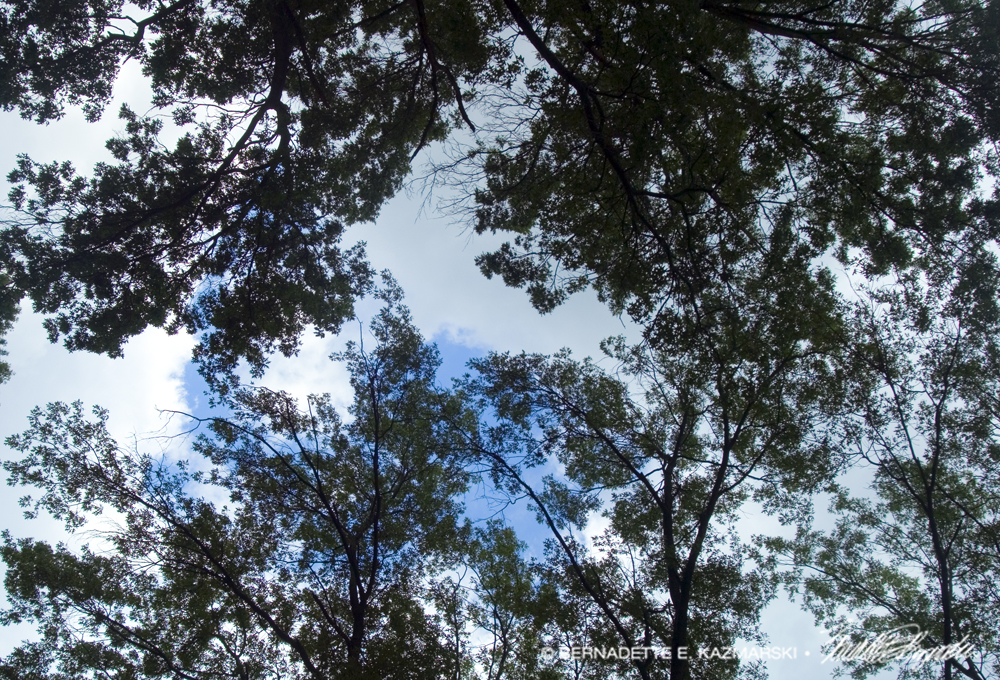
Whispering together high overhead
against a cloud-riding sky
the gentle patter of leaves in the wind
of a coming storm
is to be remembered as they are
at the height of their fullness
before the blaze of autumn color
marks the beginning of their end.
A weather front often affects the conditions far above the earth. If you listen you can hear the leaves in the treetops whispering of the change to come long before it will affect us, and sometimes I seem to hear actual words, though I know it’s just my human senses forming the sounds into a familiar pattern. But these trees know it’s an autumn storm to come, and soon their green leaves will turn to gold and red and bronze. We are enchanted by autumn colors, but they find their true identity when they are still green and strong.
There is always more to another’s life than we know in our experience of them.
There used to be a house here
snug against the hill
three floors
and steps to an upper terraced yard
in this impossible spot.
Breakfasts, dinners, Christmas trees, hot summer nights,
births, deaths, first days of school, graduations, conspiring teenagers,
changing colors of paint and people.
That was before the road was this busy
and its door opened right into traffic.
Now all that is left is a limestone foundation
and broken plastered walls with faded pink paint
embedded into the layered shale hillside,
and a chipped whitewashed alcove where the Blessed Virgin Mary
once spread her hands and watched over the home from the upper terrace.
Soon even that will be gone
and a new road will carry away
the last memory of the founders of this place,
but foundations are beyond physical presence,
and ours to build upon.
I am always sad to see old neighborhoods decay and fall to the wrecking ball, buried under with the backhoe. I’m not against progress, and sometimes a neighborhood has lived its span and is ready to be removed. But for better or worse, those old neighborhoods carry memories of individuals and the collective, people lived and died there, and they are the foundations of what we are today. Without them we are in danger of forgetting both the good we’ve done, and the bad, at risk of forgetting our roots and also repeating the same mistakes we made in the past.
This photo was taken in a city neighborhood, obviously on the top of a hill with an incredible view, a Victorian-style house that fell to decay after standing empty a decade or so and needed to be taken down for the safety of the neighborhood.
The poem was written as I watched what had been a two-lane road out of the city, which had at one time been a thriving neighborhood all on its own, wither as the road became busier and wider, and the homes and businesses closed and stood unused. Seeing the stately old houses, some with lace curtains still in the windows, fall apart and be removed, revealing the pastel paint colors of the walls, faded flowered wallpaper, the structures of what people had made their own home place, thinking of the lives and events that might be forgotten in the process, I wrote a reminder of what might once have been there.
It rained this morning, softly whispering in the trees all around the house, and I have been remembering my little Kelly and this poem inspired by her and a certain drizzly summer morning in 2009. I could have no better tribute to her gentle and loving personality than a poem that also touched many others and won an award. August 11 was the day she left us in 2012, an abandoned or former feral kitty with a long story to tell.
Pawprints and Raindrops
in the early morning, still dark
and little Kelly, sensing my awareness
hurries over and steps on my back;
I feel her tiny cold paws dimpling the surface of my skin
as I drift off in the murmur of her purr and the rain
I think of raindrops on water,
I am the water, my skin the surface
and I can look up and in the increasing daylight
see the circular ripples of contentment
mingling on my own surface.
You can listen to the poem too—see the link below.
About the poem…
Kelly really did this one early Saturday morning in 2009. I listened to the rain in the blue light of early dawn and she knew I was awake and came over and walked all over my back, purring. We were the only ones awake. Kelly had tiny paws and they were always cold, something that was uniquely her, and picturing those tiny paws dimpling my skin through the sheet as she walked on me was what connected the rain, the water, Kelly and me. I remember visualizing the lines of this, images first, descriptive words later.
You can also read the account of that day in 2011 in “Where’er You Walk“.
I’ve been working on her story as a book inspired by the five-part rescue story I wrote about her, “A Little Bit About Kelly”, which is what it started out to be, before I realized how much she had to tell.
At a bend in the trail,
The scent of wild apples greets me.
A tree abandoned from an old orchard
Or sprung up on its own from old stock, wild and uncultivated,
Stands trailside,
Heavy with small round burnished apples.
The late summer heat releases their scent,
Sweet and tart, that the world may know they have reached their prime;
The wild perfume of the coming season.
From another tree one single leaf lets go
And falls, papery, dry and curled, slipping through branches
Clattering to the summer-hardened clay of the trail,
Loud in the silent heat of the August afternoon.
Months before,
Winter lost her grip, and, one by one,
The wildflowers of spring began to bloom,
Which, in their turn, faded into the shadows of the dense summer woods.
Now summer is losing her strength,
Autumn is thinning the woods
And bearing her own flowers and fruits,
Changing the palette of the landscape
With bright summer greens turning gold,
Deep rich shadows fading hazy blue.
Soon autumn will blaze along the trail,
And songbirds will move their chorus south.
Already winter has touched my hair,
And the smell of wild apples is in the air.
Seasons meld from one to another, not at the equinox and solstice but halfway between, in the quiet time when there are no other celebrations, but the sensitive person can feel the change, especially standing in the quiet relentless heat of a backwoods trail in August. I visited the trail on the traditional Celtic cross-quarter Lugnasadh and the Christian Feast of Lammas, when summer gently gives over to autumn, growth turns to ripening, the natural world begins to settle itself in for harvest and rest in the dark of winter, and later that day the sense of change, in the woods and in myself, was still strong with me, and I wrote this poem. It became a symbol and celebration of my own developing changes, my mother’s failing health and ultimate death, and reaching my own half-century mark shortly after, seeing that as my own Lugnasadh.
Also enjoy a recorded version including a slideshow of images.
We notice these changes in ourselves in the great cycle of our own lives. I had drafted this poem during an earlier summer, but I finished it for my first poetry reading, which was at Andrew Carnegie Free Library & Music Hall in Carnegie.
The gradual changes we barely notice were the topic of my 2009 poetry reading at Andrew Carnegie Free Library & Music Hall, Change of Season. I have published the collections of poetry from each of the four poetry readings, 2007 through 2010, in a book entitled Paths I Have Walked, which you can purchase on my poetry page on this website and also the Books section of my main website.
I’m proud to offer a folio of my poetry
Paths I Have Walked: the poetry and art of Bernadette E. Kazmarski
Paths I Have Walked, collected poems.
FROM FOUR ANNUAL POETRY READINGS AT ANDREW CARNEGIE FREE LIBRARY & MUSIC HALL IN CARNEGIE, PA
People who attended one or more of my poetry readings encouraged me to publish some of my poetry in a book from the beginning.
Once I completed my 2010 poetry reading, my fourth featuring the final piece of artwork in the “Art of the Watershed” series, I decided it was time to publish something and it should be those four poetry readings.
Poetry books are not best-sellers; it’s difficult to convince a publisher to risk effort on a beginning poet, and while self-publishing is the best option it’s not inexpensive and once you’ve got the book, someone’s got to market it. Plus, I’m a graphic designer and I designed books for years, and I want things my way.
All of this is a recipe for a little bit of trouble, but I decided the book was well worth the effort so I designed the book myself and had a set printed—no ISBN or anything formal, but it’s a start! I’m really excited to offer it.
Books are 4.25″ x 11″, 40 pages of information and poetry, with glossy covers featuring “Dusk in the Woods” and little thumbnails of all four pieces in “Art of the Watershed”.
$10.00 each including shipping (they are oversized for mailing first class).
[ss_product id=’4d58d776-e639-11e5-bf63-0cc47a075d76′ ]Books, Paths I Have Walked[/ss_product]
About the books and the poetry readings
My biggest inspiration for poetry, prose and artwork is the world right around me, and I enjoy the opportunity to share it from the perspective of one who walks and hikes and bikes and carries a camera, art materials and journal everywhere—even around the house—so the inspirations are fresh.
In December, 2006, two of my poems were chosen to be published on a section of the Prairie Home Companion website entitled “Stories From Home/First Person” for submissions of writing about the place we feel most familiar. I’m a long-time listener to PHC and reader of Garrison Keillor’s books as well as a daily listener to The Writer’s Almanac featuring news about writers and writing and of interest to writers as well as a poem, all compiled and read by Keillor himself. I was astonished to find my poems were among the first chosen from apparently thousands, and so happy to be able to share them with a potential audience of so many similarly inclined writers and readers.
My poetry readings and art exhibits were the vision of Maggie Forbes, executive director of the Andrew Carnegie Free Library & Music Hall, after learning of my publishing of those two poems. I owe her many thanks for encouraging me to present this combination of my visual and literary art, a first for me. I love that building, every inch of it, and the opportunity to bring people in to visit is an honor.
Green, green waves ahead
diminishing to blue over the northern horizon
exalted rises and shadowed valleys gradually made plain
to rolling hills and misted hollows
interstate unrolled as ribbon
around hill and following valley,
signs noting unseen destinations
bearing hopeful small town names:
“Freedom”
“Prosperity”
“Harmony”
little hamlets of Pennsylvania coal being crushed to diamonds,
glittering in the vales;
a gauze curtain of rain shower flows across hills
soaking opposite side of road
but the sun shines brightly ahead,
occasionally a sudden cluster of official orange obstructions
gives instructions to change directions
slowing pace to allow a close and careful study
of native plants along the roadside,
a stately brick farmhouse, a skull with empty windows, abandoned,
its outbuildings only roofs in the tall grass
as if melting back into the earth from whence they were created;
then a curving exit that leaves the noise of four lanes behind a rise,
a sojourn on a quiet two-lane three-digit backroad,
once the lifeline before the interstate, now empty;
clusters of buildings at intersections, one traffic light flashing yellow,
old farms and equipment,
rusted industrial structures,
a field gone entirely to Queen Anne’s Lace,
some cows on a hillside,
and everywhere roadside stands
celebrate the first flush of mid-summer bounty;
collect loose change from pockets and floor of car
and with the dole,
buy fresh homegrown sweet corn to feed thy soul.
In December, 2006, two of my poems were chosen to be published on a section of the Prairie Home Companion website entitled “Stories From Home/First Person” for submissions of writing about the place we feel most familiar; this poem was one of those selected. I’m a long-time listener to PHC and reader of Garrison Keillor’s books as well as a daily listener to The Writer’s Almanac featuring news about writers and writing and of interest to writers as well as a poem, all compiled and read by Keillor himself. I was astonished to find my poems were among the first chosen from apparently thousands, and so happy to be able to share them with a potential audience of so many similarly inclined writers and readers. Every time I take that ride north on the interstate in the summer all the scenes and lines from the poem come back to me.
They tried to re-create the sun
in all its round perfection,
a flat perfect disc,
in stone.
They set their creation on its edge
to work the surface smooth
and the edge clean
like the life-giving orb they worshipped,
but it began to move on its own
smoothly along its own track.
They followed.
It was magic.
The sun moved through the sky
by means no mortal could see.
Now this hand-made sun moved along the earth
by similar means
but they knew, somehow, the portent of this moment
as they followed their stone disc
as it rolled slowly down the path
as if it was patiently showing them
the way.
As a child I remember the first times I realized the world had not always been as it was then, and especially considering a world without most of what I knew, a blank slate, yet to be discovered, made me a little fearful but very excited. How did a tree come to be called a tree? How did people figure out how to make bread? Most of what I saw had been invented or developed on the back of centuries of other discoveries, then taught and refined. But how were the origins discovered? Was it all by accident?
One day years later, as an adult, the idea in this poem came to me.

 All Rights Reserved. ♦ © Bernadette E. Kazmarski ♦ PathsIHaveWalked.com




 I wrote this poem in 2009 but finalized it just in time for my


