Clouds

Autumn-1000px

Roiling clouds blown by winds
Before a summer thunderstorm,
Huge constructions in purple and blue
And lurid green tinged with coral.

The delicate lace of a fair summer day,
Puffs and wisps in white and cream
Shaded with lilac and blue
And edged in yellow.

Hazy wisps in autumn
Moving slowly from one horizon to the next,
Never amounting to much.

The heavy purple rainclouds of a late spring afternoon
Looming on the horizon
Shadowing the early wan sun
And promising a rainy night.

The approach of the first storm of winter
As flat gray clouds form in the west,
In their shadow bringing the first reminder
Of the eternal cold of year’s end.

poem copyright 2000 © Bernadette E. Kazmarski


I’ve always loved the language of the sky. I grew up on top of a hill where I could see lots of sky in all directions. Though we lived in a suburban development the open sky was freedom from all the congestion below, and I watched them march overhead, across the valley, in all seasons. Watching the sky was like watching the facial expressions of a deity.

When I had my first solo art exhibit, in addition to the artwork, I worked my writing into the exhibit by pairing images with poems or essays or statements to make little flyers that I could print out on 8.5″ x 11″ paper and mount on the wall. Even though no line in the poem describes the painting, I used the poem Clouds with the purple clouds of an autumn rain looming over the bright trees surrounding a waterway in “Autumn”, part of the four seasons series of paintings.

Clouds, poem for display.

You can read about the exhibit and the series of paintings as well as my integration of my visual and literary works in The Extraordinary in the Ordinary.


Read more:   Essays   ♦  Short Stories  ♦  Poetry

All Rights Reserved.   ♦   © Bernadette E. Kazmarski   ♦   PathsIHaveWalked.com

www.bernadette-k.com

Before the Change

Before-The-Change-2-1000px

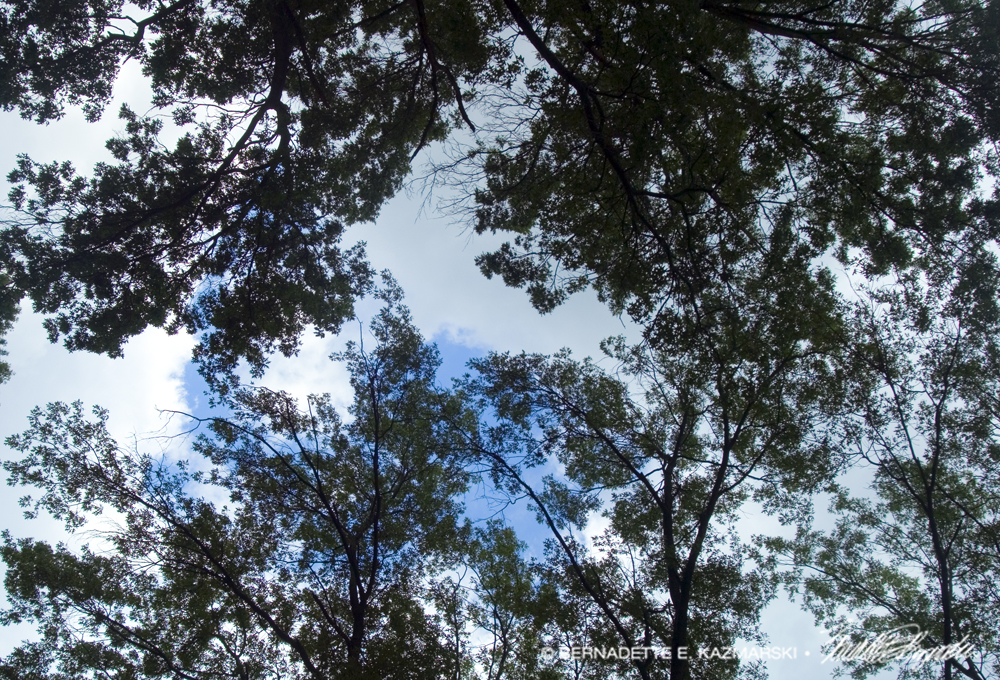
Whispering together high overhead
against a cloud-riding sky
the gentle patter of leaves in the wind
of a coming storm
is to be remembered as they are
at the height of their fullness
before the blaze of autumn color
marks the beginning of their end.

poem copyright 2011 © Bernadette E. Kazmarski

~~~

A weather front often affects the conditions far above the earth. If you listen you can hear the leaves in the treetops whispering of the change to come long before it will affect us, and sometimes I seem to hear actual words, though I know it’s just my human senses forming the sounds into a familiar pattern. But these trees know it’s an autumn storm to come, and soon their green leaves will turn to gold and red and bronze. We are enchanted by autumn colors, but they find their true identity when they are still green and strong.

There is always more to another’s  life than we know in our experience of them.


Read more:   Essays   ♦  Short Stories  ♦  Poetry

All Rights Reserved.   ♦   © Bernadette E. Kazmarski   ♦   PathsIHaveWalked.com

www.bernadette-k.com

Five Sentence Fiction: Foretold

Sluggish Bumblebee

The morning’s brilliant sunshine belied the cool air, but the bumblebee, sluggish at breakfast on the spent seed head, foretold the change to come. The season had been awaiting the moment and the moment was here, and even as the day warmed and the bees efficiently bumbled on their way, grand and beautiful clouds appeared on the horizon, slowly, quietly parading across the sky, their size and numbers more dense each hour until by afternoon the blue overhead was hung with dreamy cotton and the voice of the wind whispered high in the treetops of what was to come. The day grew darker and more quiet until by early evening all was so still and dim that when the first few whispering patters of rain began their sound was clear, though unintelligible, as if speaking a language, like that of the trees, not of this place.

The rain fell quietly all night, lovingly soaking the hardened earth of late summer until, sated, it slept. As the next morning dawned the rain slowed and stopped, the clouds parted and cleared in a reverse of their arrival the day before, leaving the sun to shine brilliantly in the blue dome of morning, but the heat was gone from the earth, once again, for another season.

~~~

I composed this story for a weekly writing challenge, “Five Sentence Fiction”. The keyword was “Breakfast”. I took “breakfast” as a time, not an event or a food because in the heat of August I was impatiently waiting for the season to change.

NewFSFBadge-1


Read more:   Essays   ♦  Short Stories  ♦  Poetry

All Rights Reserved.   ♦   © Bernadette E. Kazmarski   ♦   PathsIHaveWalked.com

www.bernadette-k.com

Short Story: The Evening Star

The Evening Star

The dusk deepened as she walked up the winding trail through the trees. At the top of the hill, at the edge of a clearing, a cliff with a steep drop to a river gorge created a break in the woods and allowed a view far into the distance, and there this dim dusk among the trees would brighten again to the last light of a summer evening, coloring the sky and clouds overhead in warm shades from coral to cobalt.

She had discovered the lookout while hunting, and visiting this place to watch the sun set and the stars appear had become a comforting routine for her. This time of day, the progression of the sun to the horizon and slipping below it, the gently deepening darkness and the animals preparing for sleep or beginning nocturnal habits, was so much like home that she could forget she was in a new place. Visiting, and frequently, eased the deep sadness that she would likely never see her home again.

Adjusting to the differences had not been so difficult as she had thought. In most ways this place was just more primitive, which they had known and prepared for. They’d all had to rely on a combination of the anthropological history they’d learned and survival skills some of them had picked up by choice, enjoying breaking free of the highly technical rigors of modern life to walk away from it for a while.

Ironic, too, how many of them had learned their survival skills in professional team-building sessions, never knowing they’d end up using the primitive skills as much as the team-building.

Reaching the top, she walked to the edge and stood, her gaze scanning slowly from one side to the other, rolling over the panorama, stopping briefly on recognizable elements in the landscape, their little settlement, a particularly large tree, a small stream, then lifting her gaze to the sky around and above her, looking from the brilliance of the early sunset to the deep blue on the opposite horizon.

The day had been hot; this new climate was challenging. The cool touch of the evening breeze now brushed past her rising from the valley below, ruffling the tall grasses like a playful hand and sifting through the trees beyond, refreshing and relaxing her, the open space soothing as she stretched and breathed deeply the rising dampness of the coming night.

This time of day had always been pensive for her, and finding this spot had given her the place to go to review the day. Nearly a year had passed since they’d landed here, and on the day they’d arrived the evening had been much like this, so much like home that she had felt welcomed, and buoyed with hope that they had done the right thing.

Four seasons had transpired, slipping one to the next much more quickly than they were accustomed to, but they’d still had time to prepare shelter and food and adequate clothing. In that time they’d honestly managed to pull together as a team and build a small community, a fact which, upon reflection, had surprised many members, thinking they were already a tight group. A shared need for survival can either bring people together or put them into competition with each other. This first year had brought out talents, built relationships and formed leaders, though not without hot debate and some raised hackles now and then.

Only three members had been lost to accident. Learning to function in the wilderness none of them were accustomed to, these deaths had been difficult and frightening and brought a big dose of cruel reality to their experience, but they had managed to hold together, grieve together and bury their dead together. There had been a two natural deaths, too, a cancer none of them could do anything about in this primitive place despite all the modern tools and medicines they had packed in preparation, and heart disease left untreated by medication no longer available, a frustrating predicament for people as advanced as they had believed themselves to be.

Only one person seemed to have snapped from the stress of it all, and he had angrily decided to leave the group, packed as many provisions as he could carry, and took off following the river. He was angry because no one was willing to explore beyond a day’s journey and look for civilization in this place, other people, cities, modern conveniences rather than sitting and waiting for death. He was the only truly single person in the group and determined this was his role because he’d leave no one behind.

His outburst had come about after one of the accidents, a horrible fall down a cliff that had left one of the women paralyzed but screaming in pain, and all they found they could do was sedate her and keep vigil until they determined it was time to use the euthanasia drug they had brought with them for instances like this.

It was true, before that accident they had been approaching the whole thing as an adventure, as if it was one of their team-building wilderness sessions that would soon be over with assistance and rescue right over the next ridge if necessary, because of course they would be going back one day. Watching her suffer, a beloved friend, unable to do anything, they had suddenly realized how alone they were, how limited, that one by one they would all die in one way or another and in some future years there might be no trace left of them at all. And as if each of them had come to the same understanding as a group through that incident, also the idea that traveling back home, or even communicating with their home planet, was unlikely to happen, in their lifetimes, if ever.

But they were so few, down to twenty-seven now, and to send anyone off into the wilderness was simply to suffer another loss. Three children had traveled with them, and no doubt there would be more, but it would be ages before there were enough of them to spare a small group to travel and start charting the area beyond their small valley. They were scientists, had been trained for this and had brought their instruments, but plain old survival took more time than they liked to admit. They had decided not to hunt animals because of the risk, but still all of them really needed to search and gather, and cook and preserve food, and make and mend clothing, not to mention the nightly challenge of attempting to communicate with equipment that didn’t work well in this climate and needed maintenance they could barely provide.

She knew that her not-so-long-ago ancestors had lived like this, and while she had known their life was difficult she had never realized just how difficult, how fragile life itself was. Her confidence—no, arrogance—as a scientist had led her to think her race would never have to endure that again. She wondered how her ancestors had ever managed to not only survive but flourish and accomplish things not found anywhere else in the universe with these everyday challenges of just getting enough food to eat.

Though everyone doubted now that anything resembling civilization existed here, they had gladly given their friend what he felt he needed and sent him off, not expecting to see him again but secretly hoping he would somehow find civilization and bring it back to the valley.

He had returned, however, just a short while ago, followed by three, well, were they people like themselves? They looked half animal with an abundance of hair and no spoken language, but they walked upright and wore rudimentary clothing, their hands were strong and dexterous using tools they had made, and they had wordlessly led members of the group around to various plants and shown them what to do with them. Although the learning curve had started quite high, they had quickly discovered the point was valuable foods and medicines beyond the capability of their own scientific equipment brought for the purpose. They did their best to express their gratitude and set up travel and communication between their two living areas, exchanging members to live in each others’ groups.

The sunset colors had reached their peak of brilliance as the sun passed behind strips of dark purple cloud edged in glowing gold, rays of light reaching upward and downward in pink and yellow, trees, rocks and the grass on her outlook glowing with the coral of the deepening evening. She waited until the sun was halfway below the horizon to the west, then turned and looked above the horizon to the east, and there it was, glowing red against the vivid deepening cobalt of the eastern sky. She’d also noticed this the night they’d arrived, like a welcoming beacon, and the clear view of it was one of the reasons she returned frequently to this spot.

It seemed to pulse, signaling perhaps. It was home, the fourth planet from the sun, the planet they’d left a little over two years before, traveling by the craft that had been built for the purpose of interplanetary travel, though their trip had been somewhat extemporaneous. That first night she had wondered if the pulsing red glow was the holocaust they had left behind still burning, the populations of their race killing each other in a misbegotten firestorm they had barely escaped, or to be honest, had simply run from. If so, the place was still burning.

The ship had stood stocked with medical supplies, food and clothing, oxygen, water and all else that would be needed during the someday trip to the third planet with the climate so like their own. It was opportune that they who had designed and built the ship and trained to pilot it were all stationed conveniently close, and by their position had been closer to their government’s plans than others as well. They had guessed that this annihilation was a possibility.

In the last few days when, despite the rhetoric that negotiations were ongoing, these leading scientists could see the missile silos being prepared for use. They passed the word among staff to get families together, pack what they could and get ready to leave if necessary. Was it selfish to save their own and use their training to take the chance on flying out, hoping they weren’t hit by a missile, and getting above the atmosphere before it became too toxic, the air polluted with radiation, carbon monoxide and debris unusable to convert to hydrogen fuel? Or was it reality that they would be the most likely to survive it if they undertook this mission and, because of that, because someone should represent their race in this universe, they should.

So they had followed the mission they had trained for, watching their planet glow with outrage until its atmosphere was so clogged with smoke and debris that they could no longer see it as they silently moved farther and farther away. They traveled without incident and landed safely in the northern hemisphere of the planet, avoiding the huge sheets of ice that blanketed the north and south poles of the planet. From studying this planet they knew the spot they landed would have been a fertile plain surrounded by low mountains and several bodies of water, safe for landing and easy for travel, perhaps rich with food similar enough to their own that they could move right in.

Of course, they had no intention to stay. Each night they signaled home base, never receiving a response which was something they had, somehow, never expected. They had planned to go back as soon as possible, even if only to see the destruction, but as time wore on they could see now that maintenance to the ship, fuel, food…so many things stood in the way that instead of months, it might be years, or generations before anyone could go back. Perhaps none of these travelers would ever know the outcome of that horrible war. How strange to go from the seeming omniscience of constant, instant communication and information to this mocking silence.

She watched as her home planet glowed ever more brightly in the deepening sky, pulsating slightly with the beat of her heart. As it rose above the horizon and the night sky deepened, the little planet was soon surrounded by stars in their familiar constellations.

They had survived almost a year here, had made contact with natives, had built a society and would someday have children of their own no doubt. Soon they planned to begin growing edible native plants rather than gathering what they needed and possibly to attempt to domesticate a few animals that resembled those from home. They’d build small towns and the struggles of power and desire would emerge, and only time would tell if they had also brought with them the potential to destroy this civilization, too, or if they had left that potential behind in the lifeless destruction on that beautiful, glowing red planet.

This story began to build itself far back, when I was still in college and reading Omni magazine, enjoying the futuristic science fiction of the late 70s and early 80s. It was to be my first novel, and I began writing in earnest immediately after graduation, dreaming of continuing on with my Master’s degree.

But life caught up with me and family issues took the time I’d carved out for writing, and I lost touch with the energy to write an entire novel. I carried the beginning draft for years, occasionally rewriting it, then in 2010, when I took the photo of the evening star which I used to illustrate this story, I decided that nothing would stop me from at least writing a short story, and so I did. As with most of my creative writing I let it sit for a while, tortured it with rewrites a few times, let friends read and critique it, and finally deemed it ready for publication, at least on my own blog.


Read more:   Essays   ♦  Short Stories  ♦  Poetry

All Rights Reserved.   ♦   © Bernadette E. Kazmarski   ♦   PathsIHaveWalked.com

www.bernadette-k.com
 

Poem for Saturday: All Our Foundations are Gone

All Our Foundations Are Gone

There used to be a house here
snug against the hill
three floors
and steps to an upper terraced yard
in this impossible spot.
Breakfasts, dinners, Christmas trees, hot summer nights,
births, deaths, first days of school, graduations, conspiring teenagers,
changing colors of paint and people.
That was before the road was this busy
and its door opened right into traffic.
Now all that is left is a limestone foundation
and broken plastered walls with faded pink paint
embedded into the layered shale hillside,
and a chipped whitewashed alcove where the Blessed Virgin Mary
once spread her hands and watched over the home from the upper terrace.
Soon even that will be gone
and a new road will carry away
the last memory of the founders of this place,
but foundations are beyond physical presence,
and ours to build upon.

poem All Our Foundations are Gone © 2010 Bernadette E. Kazmarski

I am always sad to see old neighborhoods decay and fall to the wrecking ball, buried under with the backhoe. I’m not against progress, and sometimes a neighborhood has lived its span and is ready to be removed. But for better or worse, those old neighborhoods carry memories of individuals and the collective, people lived and died there, and they are the foundations of what we are today. Without them we are in danger of forgetting both the good we’ve done, and the bad, at risk of forgetting our roots and also repeating the same mistakes we made in the past.

This photo was taken in a city neighborhood, obviously on the top of a hill with an incredible view, a Victorian-style house that fell to decay after standing empty a decade or so and needed to be taken down for the safety of the neighborhood.

The poem was written as I watched what had been a two-lane road out of the city, which had at one time been a thriving neighborhood all on its own, wither as the road became busier and wider, and the homes and businesses closed and stood unused. Seeing the stately old houses, some with lace curtains still in the windows, fall apart and be removed, revealing the pastel paint colors of the walls, faded flowered wallpaper, the structures of what people had made their own home place, thinking of the lives and events that might be forgotten in the process, I wrote a reminder of what might once have been there.


Read more:   Essays   ♦  Short Stories  ♦  Poetry

All Rights Reserved.   ♦   © Bernadette E. Kazmarski   ♦   PathsIHaveWalked.com

www.bernadette-k.com

Poem for Today: Pawprints and Raindrops

bedroomwripples-1000px

It rained this morning, softly whispering in the trees all around the house, and I have been remembering my little Kelly and this poem inspired by her and a certain drizzly summer morning in 2009. I could have no better tribute to her gentle and loving personality than a poem that also touched many others and won an award. August 11 was the day she left us in 2012, an abandoned or former feral kitty with a long story to tell.

Pawprints and Raindrops

in the early morning, still dark
and little Kelly, sensing my awareness
hurries over and steps on my back;
I feel her tiny cold paws dimpling the surface of my skin
as I drift off in the murmur of her purr and the rain
I think of raindrops on water,
I am the water, my skin the surface
and I can look up and in the increasing daylight
see the circular ripples of contentment
mingling on my own surface.

poem © 2010 Bernadette E. Kazmarski

You can listen to the poem too—see the link below.

About the poem…

Kelly really did this one early Saturday morning in 2009. I listened to the rain in the blue light of early dawn and she knew I was awake and came over and walked all over my back, purring. We were the only ones awake. Kelly had tiny paws and they were always cold, something that was uniquely her, and picturing those tiny paws dimpling my skin through the sheet as she walked on me was what connected the rain, the water, Kelly and me. I remember visualizing the lines of this, images first, descriptive words later.

CWA-BADGE_BlackMuseI wrote this poem in 2009 but finalized it just in time for my annual poetry reading at Andrew Carnegie Free Library & Music Hall in February 2010. “Pawprints and Raindrops” went on to be published on a variety of sites on the internet, and it also won both a Certificate of Excellence and Muse Medallion for poetry from the Cat Writer’s Association in 2010. In spring 2012 I began recording some of my poems, especially those with highly visual content so that I could also create a slideshow of images to accompany the text. I’ve recorded it with a slideshow of images which you can watch right here.

If it doesn’t play above, here’s the link to it on my YouTube Channel (good heavens, I have a YouTube channel): https://www.youtube.com/watch?v=vkXVjMbQTcQ

~ ~~~ ~

You can also read the account of that day in 2011 in “Where’er You Walk“.

I’ve been working on her story as a book inspired by the five-part rescue story I wrote about her, “A Little Bit About Kelly”, which is what it started out to be, before I realized how much she had to tell.


On The Creative Cat

Enjoy other poems about my cats.

Listen to other recorded poems about my cats.

Visit my YouTube site for all my recorded poems (so far).


Visit my Poetry page here on Paths I Have Walked.


Read more:   Essays   ♦  Short Stories  ♦  Poetry

All Rights Reserved.   ♦   © Bernadette E. Kazmarski   ♦   PathsIHaveWalked.com

www.bernadette-k.com

Poem for Lughnasadh: Wild Apples

Grasses and Sparkles

At a bend in the trail,
The scent of wild apples greets me.
A tree abandoned from an old orchard
Or sprung up on its own from old stock, wild and uncultivated,
Stands trailside,
Heavy with small round burnished apples.
The late summer heat releases their scent,
Sweet and tart, that the world may know they have reached their prime;
The wild perfume of the coming season.

From another tree one single leaf lets go
And falls, papery, dry and curled, slipping through branches
Clattering to the summer-hardened clay of the trail,
Loud in the silent heat of the August afternoon.
Months before,
Winter lost her grip, and, one by one,
The wildflowers of spring began to bloom,
Which, in their turn, faded into the shadows of the dense summer woods.
Now summer is losing her strength,
Autumn is thinning the woods
And bearing her own flowers and fruits,
Changing the palette of the landscape
With bright summer greens turning gold,
Deep rich shadows fading hazy blue.

Soon autumn will blaze along the trail,
And songbirds will move their chorus south.
Already winter has touched my hair,
And the smell of wild apples is in the air.

Poem “Wild Apples” by Bernadette E. Kazmarski © 2007, may not be reproduced in any way without express written permission of the author. Links to this blog are fine.

~~~

Seasons meld from one to another, not at the equinox and solstice but halfway between, in the quiet time when there are no other celebrations, but the sensitive person can feel the change, especially standing in the quiet relentless heat of a backwoods trail in August. I visited the trail on the traditional Celtic cross-quarter Lugnasadh and the Christian Feast of Lammas, when summer gently gives over to autumn, growth turns to ripening, the natural world begins to settle itself in for harvest and rest in the dark of winter, and later that day the sense of change, in the woods and in myself, was still strong with me, and I wrote this poem. It became a symbol and celebration of my own developing changes, my mother’s failing health and ultimate death, and reaching my own half-century mark shortly after, seeing that as my own Lugnasadh.

Also enjoy a recorded version including a slideshow of images.

We notice these changes in ourselves in the great cycle of our own lives. I had drafted this poem during an earlier summer, but I finished it for my first poetry reading, which was at Andrew Carnegie Free Library & Music Hall in Carnegie.

The gradual changes we barely notice were the topic of my 2009 poetry reading at Andrew Carnegie Free Library & Music Hall, Change of Season. I have published the collections of poetry from each of the four poetry readings, 2007 through 2010, in a book entitled Paths I Have Walked, which you can purchase on my poetry page on this website and also the Books section of my main website.


I’m proud to offer a folio of my poetry

Paths I Have Walked: the poetry and art of Bernadette E. Kazmarski

Paths I Have Walked, collected poems.

FROM FOUR ANNUAL POETRY READINGS AT ANDREW CARNEGIE FREE LIBRARY & MUSIC HALL IN CARNEGIE, PA

People who attended one or more of my poetry readings encouraged me to publish some of my poetry in a book from the beginning.

Once I completed my 2010 poetry reading, my fourth featuring the final piece of artwork in the “Art of the Watershed” series, I decided it was time to publish something and it should be those four poetry readings.

Poetry books are not best-sellers; it’s difficult to convince a publisher to risk effort on a beginning poet, and while self-publishing is the best option it’s not inexpensive and once you’ve got the book, someone’s got to market it. Plus, I’m a graphic designer and I designed books for years, and I want things my way.

All of this is a recipe for a little bit of trouble, but I decided the book was well worth the effort so I designed the book myself and had a set printed—no ISBN or anything formal, but it’s a start! I’m really excited to offer it.

Books are 4.25″ x 11″, 40 pages of information and poetry, with glossy covers featuring “Dusk in the Woods” and little thumbnails of all four pieces in “Art of the Watershed”.

$10.00 each including shipping (they are oversized for mailing first class).

You can order one below or on Portraits of Animals.

[ss_product id=’4d58d776-e639-11e5-bf63-0cc47a075d76′ ]Books, Paths I Have Walked[/ss_product]

About the books and the poetry readings

My biggest inspiration for poetry, prose and artwork is the world right around me, and I enjoy the opportunity to share it from the perspective of one who walks and hikes and bikes and carries a camera, art materials and journal everywhere—even around the house—so the inspirations are fresh.

In December, 2006, two of my poems were chosen to be published on a section of the Prairie Home Companion website entitled “Stories From Home/First Person” for submissions of writing about the place we feel most familiar. I’m a long-time listener to PHC and reader of Garrison Keillor’s books as well as a daily listener to The Writer’s Almanac featuring news about writers and writing and of interest to writers as well as a poem, all compiled and read by Keillor himself. I was astonished to find my poems were among the first chosen from apparently thousands, and so happy to be able to share them with a potential audience of so many similarly inclined writers and readers.

My poetry readings and art exhibits were the vision of Maggie Forbes, executive director of the Andrew Carnegie Free Library & Music Hall, after learning of my publishing of those two poems. I owe her many thanks for encouraging me to present this combination of my visual and literary art, a first for me. I love that building, every inch of it, and the opportunity to bring people in to visit is an honor.


Read more:   Essays   ♦  Short Stories  ♦  Poetry

All Rights Reserved.   ♦   © Bernadette E. Kazmarski   ♦   PathsIHaveWalked.com

www.bernadette-k.com

Support my writing with PATREON

Poem for Saturday: Road Trip, Late July, Western Pennsylvania

Summer, from The Four Seasons
Road Trip, Late July, Western Pennsylvania

Green, green waves ahead
diminishing to blue over the northern horizon
exalted rises and shadowed valleys gradually made plain
to rolling hills and misted hollows
interstate unrolled as ribbon
around hill and following valley,
signs noting unseen destinations
bearing hopeful small town names:
“Freedom”
“Prosperity”
“Harmony”
little hamlets of Pennsylvania coal being crushed to diamonds,
glittering in the vales;
a gauze curtain of rain shower flows across hills
soaking opposite side of road
but the sun shines brightly ahead,
occasionally a sudden cluster of official orange obstructions
gives instructions to change directions
slowing pace to allow a close and careful study
of native plants along the roadside,
a stately brick farmhouse, a skull with empty windows, abandoned,
its outbuildings only roofs in the tall grass
as if melting back into the earth from whence they were created;
then a curving exit that leaves the noise of four lanes behind a rise,
a sojourn on a quiet two-lane three-digit backroad,
once the lifeline before the interstate, now empty;
clusters of buildings at intersections, one traffic light flashing yellow,
old farms and equipment,
rusted industrial structures,
a field gone entirely to Queen Anne’s Lace,
some cows on a hillside,
and everywhere roadside stands
celebrate the first flush of mid-summer bounty;
collect loose change from pockets and floor of car
and with the dole,
buy fresh homegrown sweet corn to feed thy soul.

Poem © 2006, B. E. Kazmarski

In December, 2006, two of my poems were chosen to be published on a section of the Prairie Home Companion website entitled “Stories From Home/First Person” for submissions of writing about the place we feel most familiar; this poem was one of those selected. I’m a long-time listener to PHC and reader of Garrison Keillor’s books as well as a daily listener to The Writer’s Almanac featuring news about writers and writing and of interest to writers as well as a poem, all compiled and read by Keillor himself. I was astonished to find my poems were among the first chosen from apparently thousands, and so happy to be able to share them with a potential audience of so many similarly inclined writers and readers. Every time I take that ride north on the interstate in the summer all the scenes and lines from the poem come back to me.


Read more:   Essays   ♦  Short Stories  ♦  Poetry

All Rights Reserved.   ♦   © Bernadette E. Kazmarski   ♦   PathsIHaveWalked.com

www.bernadette-k.com


Essay: Ten Feet High With Jewelweed

Tips of jewelweed
Jewelweed
Jewelweed

That was my garden last year. In fact, it was most of my back and side yards, the places I’d grown my vegetables from my cold frame to my raspberry bushes, where my native plants had stood and called to the bees and butterflies and hummingbirds and songbirds, all in their season. I’d walked among them as if it was my own private park, and indeed it was, my backyard wildlife habitat, carefully organized over 25 years and giving me both sustenance and inspiration, flattened by my tree in 2016, and grazed to dirt by the white-tailed deer who had never bothered my yard before but suddenly found it a paradise of fresh browsing.

Space for a sustainable garden was imperative in my choice of a home in 1990, and I found this tiny house on a slightly oversized lot. I planted periwinkle and pachysandra in the front yard, made my side yard into a terraced rain garden with stone steps and rocks and hybrid and native plants, and no grass at all. I worked out my 30’ x 50’ vegetable garden with brick paths and raised beds and the rest of the yard in herbs and native plants, blooming and fruit-bearing and berrying shrubs, and a small area for grass managed as a meadow and filled with forget-me-nots and buttercups in spring, tiny recumbent flowering native plants in summer and fall with a fair sprinkling of herbs just for fun. When I told people my yard was a registered backyard wildlife habitat and that I had no grass but for a small patch in the back yard they imagined my home surrounded by weeds and brambles, overgrown and shabby. But my neighbors and visitors were always drawn in by following the stone, brick and wood chip paths among the growing things to see what was here, and often remarked it was so much like a park they wanted to visit it regularly, and some people did.

A view of the yard in spring.

That vegetable garden produced most of the food I ate for nearly two decades, eating it fresh and processing the rest into soups and sauces and cooked and also as frozen and canned ingredients. I started my own plants and a few years into it purchased heritage seeds and began saving my seeds as well, letting them adapt themselves into the nutrients in my soil and the light and humidity in my little ecosystem. I composted all plant waste along with my paper waste from my studio of natural fiber mat board and drawing paper and anything else appropriate. I quit using a tiller very early on, turning the soil by hand, so easy to do with all the organic matter. And with so many birds and insects all was kept in balance, I never had need for chemicals to kill off an overpopulation of insects or even to frighten off animals who would invade to eat. They didn’t invade, they lived here, and I left violets and plantain to grow along my garden paths so rabbits only nibbled the lettuce, and allowed the groundhogs to eat some bean plants and the raccoons some tomatoes if they would just stop before they had a full feast. There was enough to share for all of us. A wire fence grown over with grapevines and Virginia creeper and layered with brush piles pretty much kept the deer at bay as they nibbled on the leaves of the vines and occasionally found a way inside, simply looking beautiful against the backdrop.

A portion of my garden and yard from 2001.
A portion of my garden and yard from 2005.

And I started each day out there, in any season, always something to do, getting my exercise and fresh air, and then awakening my creative senses with my camera and sketch pad before getting to work as a commercial artist at my computer and easel. It was the best way to start any day, in the quiet of my habitat, and finding beauty in every little detail so that I could share it in what I created.

Over three years recently everything changed. One of my trees laid down under the weight of snow and ice one winter, flattening a section of fence, a neighbor’s tree fell in a storm the next year onto another section of fence and about 30 feet into the corner of my yard, then in 2016 my own beloved 70-foot wild black cherry tree simply shed all its huge branches one hot, sunny July day, covering all of my garden and back yard to my deck and beyond, and the front yard nearly to the street. The main trunk, still standing in the midst of my and my neighbors’ houses, could not be climbed to cut in sections nor could a lift be brought close and was instead cut so that it would drop at an angle across my back yard, safely avoiding all homes, structures and people.  The fall smashed my cold frame, and cleanup took many species of plants with it, dislodged my raised beds in the garden, and left me with a portion of the main trunk across the yard because it was too big to be carried off, cut up or chipped up at the time. After years of praise for how beautiful my yard was I was cited for the mess that was left of what I’d had. I found a friend who could cut up the largest portion of the tree trunk by hand and haul off the seasoning cherry wood for his family’s fireplaces, cleaned up what else I could before winter. How quickly things change.

The tree fall began a series of events that included my brother’s sudden and unexpected death the day after the tree fall, and, immediately following, the final negotiation with a mortgage company that helped mitigate the extortion another mortgage company had perpetrated over a decade, cleaning out my savings, retirement, life insurance and any other assets and extra income I’d had.

So, it was a time to start over again.

The following year, 2017, I was working hard to rebuild those assets, finalize my mother’s and brother’s “estates”, and work on repairs in my home that I couldn’t afford in the decade of the mortgage issue. I had decided to focus on these things to hasten both my finances and the finalizations, and be free to focus on running my business again.

The cherry tree had been massive and shaded the rain garden and portions of my vegetable garden. Now without it plants held in check by the deep shade suddenly sprouted, not my natives but grapevines and bindweed and poison ivy and wild yam creating a tangled mess that seemed to spread each day. I bought vegetable plants and planted a small garden in a space I’d cleared in the back, but the deer ate everything, including some of my geraniums in hanging baskets that I’d been keeping and rejuvenating each spring for more than a decade. My old electric mower rusted off its wheels, and I decided just to let it all go and focus on getting life and finances back together.

I love jewelweed. It’s one of my favorite wildflowers and I’d always photograph it whenever I found it in the woods. Never before that year, considering all the native plants I’d let sprout and grow in the wilder sections of my yard, had I seen a single jewelweed plant, even though I have always had plenty of poison ivy and sap in jewelweed leaves and stem are the natural antidote to poison ivy’s urishiol oil, and, as nature would have it, they often grow together. I would have celebrated its presence because, for some reason, I find it quietly magical and beautiful.

Just a week or two after I’d walked away from my precious habitat the jewelweed was already a foot or two tall, all over the garden and back yard. It usually grows in shaded areas in the woods so once it gets started it doesn’t waste time setting in good roots first but grows up and up to have enough leaves to photosynthesize its nutrition and then begins to bloom.

I was enchanted as it grew, taller than me, and dense. A few other things had grown too, pokeberries and burdock, but they were only ornaments on the edge of things. Even though it meant I would see only the rising forest of jewelweed and nothing else when I looked out my doors and windows on that side, it held its quiet fascination for me in its meditative vertical stems, the efflorescence of yellow flowers, and then the steady hum of many busy bees in the canopy in constant movement pollinating each flower.

Tips of jewelweed
Tips of jewelweed

In September they began to dry out and fall, crumpling onto each other in waves. At the end of last year that’s where I left things.

Considering the change brought upon me by the events the previous year, over the winter I finally had the chance to think about the previous years and plan the next, and look at what should be a part of my life and what should not.

I desperately missed my garden. Not just the food, but being part of life in that way, a part of my little patch of soil, of exercising myself and my mind without intention, just as part of my daily work. A friend with an alternative wellness practice told me I did not feel grounded, and she was right. I felt as if I was floating through what was happening, not really attached. I wasn’t even sure what foods I liked to eat anymore. That grounding for me had always come from literal contact with the ground, walking around outdoors on the dirt and the grass and the paths I built. It built my immunity both physical and emotional.

I knew I had to keep the deer in check with the fence I’d had, and I had neither the time nor the money for it. When spring came I’d contracted for frequent vendor events and knew I wouldn’t be able to do anything until after they were done since they’d represent a good part of my income in the first half of the year. I watched my yard come back to life in the way I’ve always loved it, but I also saw my front sidewalk covered over with eroded soil and opportunistic thistles, burdock and poison ivy, bindweed growing up my gutters and what was left of my lilac being smothered by wild yam. And the jewelweed was back, beginning its ascent in all places it found suit to sprout. Thinking of the deer and the fence and the mess and the time it would all take, I decided I’d probably pass again this year.

In my sedentary previous year I’d begun to feel some pain in my right hip and leg and as it grew it was diagnosed as sciatica, a condition caused by being sedentary, by sitting or standing in one place without moving. My family has a history of spinal issues and I have a bit of scoliosis; in everything else that had happened I had stopped my daily yoga practice for lack of floor space for a mat, and my old exercise bicycle was binding for some reason and I couldn’t afford to get it fixed. The first step in healing sciatica is to be mobile, work out those muscles and tendons that haven’t been stretched. Even with my vendor events I hadn’t been able to ease the pain of it because a good bit of that was standing in your booth.

I had always spent about an hour a day outside in the yard, nearly every day. I knew this was what had kept things like sciatica at bay, and the gentle walking, bending and carrying movements of gardening had kept me flexible. And a little bit a day had kept the yard a showplace for decades. I knew that my garden and yard were things that needed to be a part of my life, now and probably always. So one June morning, just a few weeks ago, I decided to just start it all up again. Down came the jewelweed, I cleared the native and perennial beds of invasives, dug up the burdock and pokeberries, and planned to get whatever vegetable plants I could find at a local greenhouse, too late to start seeds and better late than never.

In the meantime the jewelweed stems dried in the sun atop the soil, and when I planted I cut rows through them and left them in place as a mulch to protect and nurture my nascent garden of tomatoes, peppers, cabbage and squash, beans and carrots and turnips and beets. I left a few standing at the corner of my garden with the phlox for pollinators. I thank the jewelweed for arriving at my time of need and giving me a place to meditate on these decisions.

Not the prettiest, but I have the summer to work on that.

In the weeks I’ve been at this I’ve lost weight, gained strength, had pain-free days from sciatica, and am definitely looking forward to fresh foods again. I haven’t seen the deer in a while, nor have I seen signs of them. I think they understand. And I start my days outdoors for just long enough to energize myself and to awaken those creative senses that are essential to my business and my life.

And after this I hope to also have the energy and find the time to write as often as I once did.

Mimi approves too--she's been feeling kind of ungrounded lately as well.
Mimi approves too–she’s been feeling kind of ungrounded lately as well.

Also read about my art, photography, poetry and prose inspired by my backyard wildlife habitat. I’ve been sharing it for years on The Creative Cat:

Art Inspired by My Backyard Wildlife Habitat

Photography Inspired by My Backyard Wildlife Habitat

Poetry Inspired by My Backyard Wildlife Habitat

Prose Inspired by My Backyard Wildlife Habitat


Read more:   Essays   ♦  Short Stories  ♦  Poetry

All Rights Reserved.   ♦   © Bernadette E. Kazmarski   ♦   PathsIHaveWalked.com
www.bernadette-k.com

Poem for Saturday: Inventing the Wheel

Sun-1000px

They tried to re-create the sun
in all its round perfection,
a flat perfect disc,
in stone.

They set their creation on its edge
to work the surface smooth
and the edge clean
like the life-giving orb they worshipped,
but it began to move on its own
smoothly along its own track.
They followed.

It was magic.

The sun moved through the sky
by means no mortal could see.
Now this hand-made sun moved along the earth
by similar means
but they knew, somehow, the portent of this moment
as they followed their stone disc
as it rolled slowly down the path
as if it was patiently showing them
the way.

poem Inventing the Wheel © 2010 Bernadette E. Kazmarski

As a child I remember the first times I realized the world had not always been as it was then, and especially considering a world without most of what I knew, a blank slate, yet to be discovered, made me a little fearful but very excited. How did a tree come to be called a tree? How did people figure out how to make bread? Most of what I saw had been invented or developed on the back of centuries of other discoveries, then taught and refined. But how were the origins discovered? Was it all by accident?

One day years later, as an adult, the idea in this poem came to me.


Read more:   Essays   ♦  Short Stories  ♦  Poetry

All Rights Reserved.   ♦   © Bernadette E. Kazmarski   ♦   PathsIHaveWalked.com

www.bernadette-k.com