I first posted this with my daily photo on my photo blog Today and knew I’d end up drafting a poem. I began the draft there, and shared it above. We’ll see how it works out in the next few weeks or months.
Green, green waves ahead
diminishing to blue over the northern horizon
exalted rises and shadowed valleys gradually made plain
to rolling hills and misted hollows
interstate unrolled as ribbon
around hill and following valley,
signs noting unseen destinations
bearing hopeful small town names:
“Freedom”
“Prosperity”
“Harmony”
little hamlets of Pennsylvania coal being crushed to diamonds,
glittering in the vales;
a gauze curtain of rain shower flows across hills
soaking opposite side of road
but the sun shines brightly ahead,
occasionally a sudden cluster of official orange obstructions
gives instructions to change directions
slowing pace to allow a close and careful study
of native plants along the roadside,
a stately brick farmhouse, a skull with empty windows, abandoned,
its outbuildings only roofs in the tall grass
as if melting back into the earth from whence they were created;
then a curving exit that leaves the noise of four lanes behind a rise,
a sojourn on a quiet two-lane three-digit backroad,
once the lifeline before the interstate, now empty;
clusters of buildings at intersections, one traffic light flashing yellow,
old farms and equipment,
rusted industrial structures,
a field gone entirely to Queen Anne’s Lace,
some cows on a hillside,
and everywhere roadside stands
celebrate the first flush of mid-summer bounty;
collect loose change from pockets and floor of car
and with the dole,
buy fresh homegrown sweet corn to feed thy soul.
In December, 2006, two of my poems were chosen to be published on a section of the Prairie Home Companion website entitled “Stories From Home/First Person” for submissions of writing about the place we feel most familiar; this poem was one of those selected. I’m a long-time listener to PHC and reader of Garrison Keillor’s books as well as a daily listener to The Writer’s Almanac featuring news about writers and writing and of interest to writers as well as a poem, all compiled and read by Keillor himself. I was astonished to find my poems were among the first chosen from apparently thousands, and so happy to be able to share them with a potential audience of so many similarly inclined writers and readers. Every time I take that ride north on the interstate in the summer all the scenes and lines from the poem come back to me.
~~~
About the artwork
“Summer” is an abandoned farm field on a high ridge which I passed regularly on the way to work each morning for six years, seen right after an early morning storm. I would reach this portion of my drive and pause to look at this field with the morning unfolding above it, different each day, take a deep breath, and go on. The site was developed a few years later, but I still remember that each time I pass by it, even now. It’s one of a four-part commission I painted years ago featuring the four seasons in Western Pennsylvania. Read an essay about the painting, “Summer”, above, and purchase a digital, giclee or canvas print from my shop, Portraits of Animals.
You can best see the constellations by lying on your back and dreaming and in due time the sky is filled with cavorting gods and goddesses, mythological beasts, love, death, politics, art all in the air above you; yet concentration on one will cause them all to lose their magic.
So I, facing the surprise berry patch, focusing to find one berry, and then another while the clean June sun spilled over my head warming the smell of berries and leaves and dirt and small wild plants brushed the soles of my bare feet, became at the same time a small person faced with a raspberry clump taller than me, surprised to find something so joyfully abundant and free for the taking where last week there had only been leaves along this path, and, while watching the clouds forgetting the berries in both ages my hands found berry after berry and my heart found dreams.
The raspberries are finally ripening, and it’s time to go and harvest a few baskets and to visit the warm quiet places at the edges of woods filled only with the sounds of insects humming and buzzing and clicking, and birds singing to each other in the cool darkness among the trees. Though raspberry time is typically June and summer has passed its zenith, the raspberries are finally ripening in my yard and along the back roads I travel. I remember them first in the abandoned hillside pasture across the street from where I grew up, on a hot summer day, barefoot on a narrow dirt trail through the tall grasses.
Oh, I can’t stop looking at all the feverfew
in my garden,
I just keep running from one cluster to another
those tiny perfect daisies
in umbels as if floating without stems
on waves of bright green leaves
the dots of dew flashing, sparkling
in the day’s new sun
just arrived over the horizon
its color still warm and yellow
as if it’s a cookie just taken out of the oven
and I have to look at all the feverfew
from every angle
until I’m done looking
and I discover I’ve forgotten all the problems of yesterday
and all the ills of the world that I feel the need to carry
and I’m laughing
and dripping with dew myself
and visualizing stunning works of art
and amazing poetry and prose
most of which will ever be realized
nor do they need to be
the inspiration only needs to settle into my soul in this early morning in June
and its glow will warm heart
and keep me laughing with joy
through the day
and the next
and the next.
Do flowers make us happy? Especially those little smiling faces of daisies and daisy-like flowers? Used to represent a universal flower type, little white flowers with yellow centers and a circlet of white petals have always been recognized as symbols of innocence and childhood.
I’m a sucker for a little white flower, be it chamomile or a daisy or an aster or…feverfew, even the mounds of it that take over sections of my garden every summer. It’s a native wild plant in my area and once it gets a root in the soil nothing can stop it. Yet it looks as delicate and happy and innocent as a flutter of butterflies.
Through the years caring for my mother and brother, money woes and running my business, the coming in and sadly, leaving, of members of my feline family have tended to pull me deeper into myself until I can’t get past myself to my creative self that is totally unaware of all these daily things. Sometimes when I’m weighed down by everything around me, a trip to the garden and seeing little smiling flower faces dotted with dew can awaken my creative senses and lift the weight off my shoulders—and a good thing because I need all my strength and balance to run around with my camera and sketchbook. A trip to the garden in the morning pulls me out of that space for just enough time that I can reach that creative self in time for another day’s work in my studio, and my kitchen, and around my house as I smile back at all those little happy faces covered with dew and suddenly see photos and paintings and fabric designs and, for the moment, forget anything else.
Feverfew in the Garden
I’m proud to offer a folio of my poetry
Paths I Have Walked: the poetry and art of Bernadette E. Kazmarski
Paths I Have Walked, collected poems.
FROM FOUR ANNUAL POETRY READINGS AT ANDREW CARNEGIE FREE LIBRARY & MUSIC HALL IN CARNEGIE, PA
People who attended one or more of my poetry readings encouraged me to publish some of my poetry in a book from the beginning.
Once I completed my 2010 poetry reading, my fourth featuring the final piece of artwork in the “Art of the Watershed” series, I decided it was time to publish something and it should be those four poetry readings.
Poetry books are not best-sellers; it’s difficult to convince a publisher to risk effort on a beginning poet, and while self-publishing is the best option it’s not inexpensive and once you’ve got the book, someone’s got to market it. Plus, I’m a graphic designer and I designed books for years, and I want things my way.
All of this is a recipe for a little bit of trouble, but I decided the book was well worth the effort so I designed the book myself and had a set printed—no ISBN or anything formal, but it’s a start! I’m really excited to offer it.
Books are 4.25″ x 11″, 40 pages of information and poetry, with glossy covers featuring “Dusk in the Woods” and little thumbnails of all four pieces in “Art of the Watershed”.
$8.00 each plus $2.50 shipping (they are oversized for mailing first class).
[ss_product id=’4d58d776-e639-11e5-bf63-0cc47a075d76′ ]Books, Paths I Have Walked[/ss_product]
About the books and the poetry readings
My biggest inspiration for poetry, prose and artwork is the world right around me, and I enjoy the opportunity to share it from the perspective of one who walks and hikes and bikes and carries a camera, art materials and journal everywhere—even around the house—so the inspirations are fresh.
In December, 2006, two of my poems were chosen to be published on a section of the Prairie Home Companion website entitled “Stories From Home/First Person” for submissions of writing about the place we feel most familiar. I’m a long-time listener to PHC and reader of Garrison Keillor’s books as well as a daily listener to The Writer’s Almanac featuring news about writers and writing and of interest to writers as well as a poem, all compiled and read by Keillor himself. I was astonished to find my poems were among the first chosen from apparently thousands, and so happy to be able to share them with a potential audience of so many similarly inclined writers and readers.
My poetry readings and art exhibits were the vision of Maggie Forbes, executive director of the Andrew Carnegie Free Library & Music Hall, after learning of my publishing of those two poems. I owe her many thanks for encouraging me to present this combination of my visual and literary art, a first for me. I love that building, every inch of it, and the opportunity to bring people in to visit is an honor.
The dogwoods are blooming up and down my street.
The breaking of the cold,
The unusually warm, brilliant spring day
Has brought my neighbors out to wash cars and cut grass.
Like the returning birds
Their conversations drift and circle from yard to yard
And cross the street on capricious breezes;
We have been put away all winter
Like articles of summer clothing
Our potential at rest,
Yet now, even at night,
Pale, airy clouds of blossoms
Hover in the darkness all over the neighborhood.
I’ve never seen another dogwood like mine except out in the woods here in western Pennsylvania, which is where I found it. With friends, I was exploring an old abandoned farm that had been sold for development. A long row of blooming daffodils lined the driveway, leading us to the spot where the house had been; only an open rectangle of grass was left, but it was surrounded by forsythia and roses and lilacs and Star of Bethlehem spilling around in the grass and many, many more plants which would have bloomed all through the growing season. Someone had loved growing things and so did we, so we took what we could to preserve their memory knowing they’d only be plowed under.
Off in the woods, irregular clouds of white blossoms lit the shadows along what had been roads or paths to outbuildings, and we found lovely native dogwoods with the largest flowers I’ve ever seen, at least four inches across with creamy ridged petals and the characteristic divot at the end of each. What had been but a twig growing on a hillside in the woods is now a full and fervent tree with white flowers in spring, dense green leaves all summer, bright red fruits in late summer and red-violet leaves in fall. Who could improve on that?
After a long exhilarating day of spring yard work, as it bloomed in my yard I saw it at night, a hazy glowing shape, the light of spring that could not be extinguished even by darkness. Hence, this poem.
In December, 2006, two of my poems were chosen to be published on a section of the Prairie Home Companion website entitled “Stories From Home/First Person” for submissions of writing about the place we feel most familiar; Dogwoods and Road Trip, Late July, Western Pennsylvania were both chosen as two of the first entries and led to my annual poetry readings—more on that below.
Read more poetry here on Today or visit my poetry page to see more about my poetry and other writing, and to purchase Paths I Have Walked.
I’m proud to offer a folio of my poetry
Paths I Have Walked: the poetry and art of Bernadette E. Kazmarski
Paths I Have Walked, collected poems.
FROM FOUR ANNUAL POETRY READINGS AT ANDREW CARNEGIE FREE LIBRARY & MUSIC HALL IN CARNEGIE, PA
People who attended one or more of my poetry readings encouraged me to publish some of my poetry in a book from the beginning.
Once I completed my 2010 poetry reading, my fourth featuring the final piece of artwork in the “Art of the Watershed” series, I decided it was time to publish something and it should be those four poetry readings.
Poetry books are not best-sellers; it’s difficult to convince a publisher to risk effort on a beginning poet, and while self-publishing is the best option it’s not inexpensive and once you’ve got the book, someone’s got to market it. Plus, I’m a graphic designer and I designed books for years, and I want things my way.
All of this is a recipe for a little bit of trouble, but I decided the book was well worth the effort so I designed the book myself and had a set printed—no ISBN or anything formal, but it’s a start! I’m really excited to offer it.
Books are 4.25″ x 11″, 40 pages of information and poetry, with glossy covers featuring “Dusk in the Woods” and little thumbnails of all four pieces in “Art of the Watershed”.
$8.00 each plus $2.50 shipping (they are oversized for mailing first class).
[ss_product id=’4d58d776-e639-11e5-bf63-0cc47a075d76′ ]Books, Paths I Have Walked[/ss_product]
About the books and the poetry readings
My biggest inspiration for poetry, prose and artwork is the world right around me, and I enjoy the opportunity to share it from the perspective of one who walks and hikes and bikes and carries a camera, art materials and journal everywhere—even around the house—so the inspirations are fresh.
In December, 2006, two of my poems were chosen to be published on a section of the Prairie Home Companion website entitled “Stories From Home/First Person” for submissions of writing about the place we feel most familiar. I’m a long-time listener to PHC and reader of Garrison Keillor’s books as well as a daily listener to The Writer’s Almanac featuring news about writers and writing and of interest to writers as well as a poem, all compiled and read by Keillor himself. I was astonished to find my poems were among the first chosen from apparently thousands, and so happy to be able to share them with a potential audience of so many similarly inclined writers and readers.
My poetry readings and art exhibits were the vision of Maggie Forbes, executive director of the Andrew Carnegie Free Library & Music Hall, after learning of my publishing of those two poems. I owe her many thanks for encouraging me to present this combination of my visual and literary art, a first for me. I love that building, every inch of it, and the opportunity to bring people in to visit is an honor.
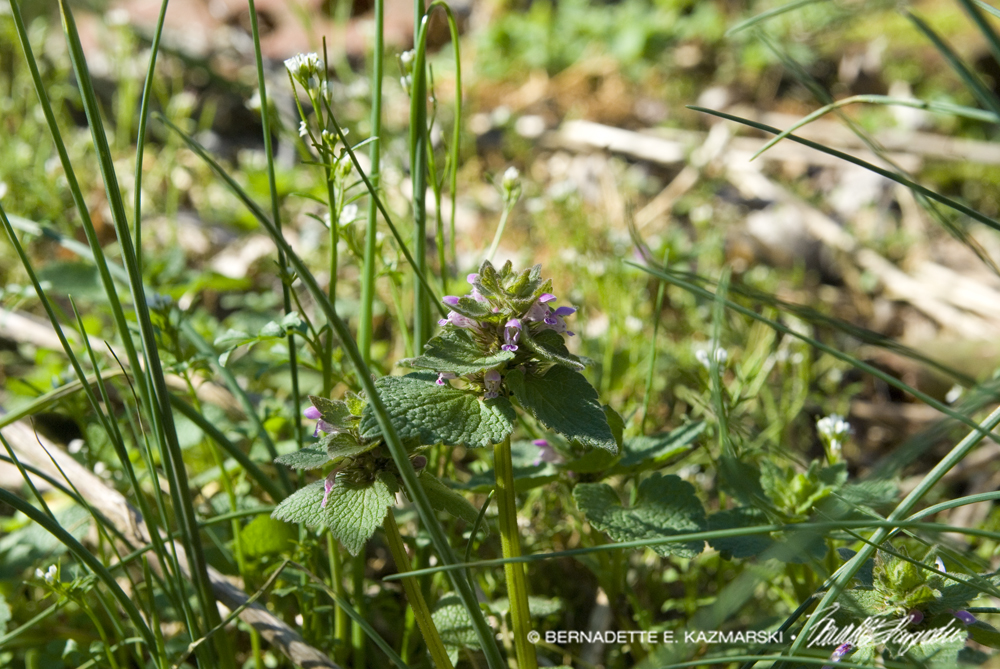
Dead nettle,
bittercress,
wild garlic,
once healing tonics
taken in spring,
today only weeds,
unwanted,
except by me
for my eyes and palette
served in a bed of vivid fresh greens.
So much is wrong So much is sad So much cannot be fixed The detritus of the past lies all about But I find also diaphanous angel wings filled with eternal sunshine Bright smiling eyes of faerie flowers Reflecting the tranquil blue of the sky’s protective arch The old daffodil has stories to tell And joy appears in the most common of things Beauty, good, exist in every moment Like the stars in daylight Always shining But only seen in the darkest hour.
Winter is finally is beginning to give over to spring after a few false starts, and I am finding flowers in my yard. We all walk through difficult times and feel as if spring as a metaphor for relief, healing, rest, or morning after a long night will never come, but it does because in fact is always there hidden by what we expect to see. Sometimes all we need to do is look around us, and there it is.
The words came to me inspired by the beauty in a humble spring morning in 2015. At that time this was a poem in progress, but now it’s graduated to a finished poem. Below is a slideshow of other photos that inspired these words.
Please feel free to download and share this graphic I made for social networking.
In this sepia scene of late-winter twigs and matted leaves I found the small tattered orb she had built that lasted the winter, this tiny creature no larger than a grain of sand now curled in the center, her spirit long
gone from her desiccated body, yet her tiny children, awakened by a warming spring sun, will emerge from all the crevices in the plant she chose as their birthplace and find that her final creation helps provide their first meal, delicate strands catch the earliest gnats, though these too be the children of other mothers
full of hope for the generation of children
they will never meet; and so the returning songbirds will catch the tiny spiders as they leave their web of safety and find sustenance to begin their families all life toiling through the year to grow and thrive to prepare for the dark of winter and to come, again, in spring.
As the spring unfolds with longer days and milder temperatures, we remember what has passed.
It was the tiny spider in the delicate, worn web that inspired this slideshow from 2009 and poem from 2011.
Each year I leave the plants in my garden standing for the birds, insects and other residents of my garden to use for winter accommodations. In spring of 2009 I began preparing the garden section by section and happened to see this spider and her delicate web outlined in the spring sunshine. She had died long before but continued to cling there all winter long, and her web held up against any number of storms.
Her eggs would have been laid on the stem adjacent to her web which would catch the first insects in spring, and when they hatched the little spiders could have their first meal of the insects caught in the web and use her web as a launching pad. I found it so moving that on that bright early March afternoon I went through my garden looking for other such images.
All the other native plants had left behind their skeletons, and the effect of these was haunting, like finding a ghost town or an unknown world.
I had to let them say their last goodbye. I photographed each desolate construction with attention to extreme details you might never notice to show the intrinsic, transient beauty of these empty shells. The sepia tones are the natural coloring of the plants in the stark spring sunlight, that interim color palette between the blues of winter and the greens of spring. Here is a link to the original slideshow of photos taken that day; when you view it, you’ll see that many of the plants I’ve photographed are criss-crossed with tattered little webs.
I read this poem at my 2011 poetry reading at Andrew Carnegie Free Library & Music Hall, but did not set up a web page for that reading, and it is not included in my poetry book.
In 2017 I found another inspiration in these “Winter Leftovers”: What Stays With Us.